Last Monday, Superintendent of Schools John Doherty gave the annual State of the Schools Address at the opening session of Town Meeting. A transcript of the speech is below. The power point presentation that accompanied the speech is located here.
Town Meeting State of the Schools Speech-November 9, 2015
Mr. Moderator, Town Meeting Members, Board of Selectmen, Finance Committee Members, School Committee, Fellow Town Leaders and Department Heads, Building Principals, District Administrators, Members of the School Community, and Invited Guests. It is with great honor and privilege that I present to you the 2015 State of the Schools Address. One of the traditions that I look forward to each year as Superintendent is to recognize and introduce to you the Reading Memorial High School Seniors who are receiving the Massachusetts Association of School Superintendents Award for Academic and Community Excellence. This year, I will be recognizing two outstanding students, each who have a strong three year cumulative academic average, participate in extracurricular and community service activities, and are currently in the top 5% of their graduating class. Each year, it is always difficult to only select two students given how many deserving candidates we have shining here at Reading Memorial High School. It is with great pride that I present this award to the following individuals:
Our first recipient attended Killam Elementary School and Parker Middle School and serves in leadership positions as the Vice President of the National Honor Society and Captain of the Indoor and Outdoor Track Teams. He aspires to continue to run track when he is in college. He is a youth leader at the Korean Church of the Nazarene, volunteering as a mentor to younger members. Over his four years, this student has taken 8 AP Courses, the maximum number possible at RMHS. He is currently taking Honors and Advanced Placement classes in Calculus, French, English, Computer Science and Statistics. This recipient has applied to several colleges and universities including Tufts University, where he plans on majoring in biochemistry and pre-medicine. It is with great pleasure tonight that I recognize Paul Chong. Paul, please come forward to receive the 2015 Massachusetts Association of School Superintendent’s Award.
Tonight’s second recipient attended Killam Elementary School and Coolidge Middle School and has excelled as a member of the RMHS Drama Club and in the past has been a member of the RMHS Volleyball Team. This student also volunteers at the Mission of Deeds every Monday. Last year, this individual received the esteemed Brown University Book Award for her high level of academic achievement and this year, she was invited by the College Boards to participate in the National Hispanic Recognition Program for being in the top 2.5% among Hispanic and Latino students in the country for her score on the PSAT/NMSQT Exam and for achieving at least at 3.5 G.P.A. in her coursework. A member of the National Honor Society, this recipient is currently taking Advanced Placement and Honors courses in English, Engineering, Calculus, French, and Biology. Next year, she also plans on majoring in Biochemistry and has applied to WPI and Marist.
It’s a great honor to introduce to you, Isabel Azevedo! Isabel, please come forward and accept the MASS 2015 Superintendent’s Award for Academic Excellence.
Congratulations Paul and Isabel. Tonight’s sharing of accomplishments does not stop with recognizing these two students who personify the educational journeys which our schools strive to inspire, teach, and support. The main objective of this annual Address is to report on the state of the schools—and without question, our school system could have no finer examples of its mission than these two outstanding young adults and many more like them. Schools across the country are experiencing educational, financial, and political challenges. Our district strives to meet these challenges with cutting edge curriculum, creative best practices and funding, cross staff collaboration and learning, and the tenacity which engages families, staff and community in preparing our students for their world and the challenges that they will face. Tonight, I will highlight some of our accomplishments from this past year, and share with you some areas that we are focusing on as we strive to become the best PreK-12 school district in our region.
To highlight our successes, we have distributed two documents this evening which capture the 2014-15 school year. The first document focuses on the accomplishments of our entire PreK-12 district and the other, the RMHS School Profile, is specific to our high school and is distributed to colleges and universities across the country. These accomplishments would not be possible without a dedicated and caring staff, strong leadership from our administrators and directors, and the financial and volunteer support that we receive from our parents and our community. An example of this support is that during the 2014-15 school year, our parent groups, community organizations and private citizens donated over $160,000 to our schools and programs in a variety of ways. It is this spirit of collaboration, commitment and teamwork that helps contribute to the success of our school district.
We have a lot to be proud of as a community and we need to take the time to celebrate those successes. Whether it is our RISE integrated pre-school which does an amazing job with our three and four year old students or our elementary schools which are committed to building strong communities of learners in literacy and mathematics, or our middle schools which have provided many powerful learning opportunities for students during a very challenging developmental stage in their lives, or our high school, which challenges our students to explore their passions so that they can be prepared for college or career opportunities, our district is a solid example of how we are working together to instill a joy of learning and inspire the innovative leaders of tomorrow.
This is evident with our latest graduating class of 2015, where 93% of the students are continuing on to post-secondary education, including 88% going on to a four year college or university. Last year’s Senior Class achieved national academic success on the Advanced Placement and SAT Tests with 16 national merit commended scholars and one student, Peter Satterthwaite, who received recognition as a national merit finalist and, was one of only fourteen students in Massachusetts who qualified for the prestigious United States Presidential Scholars Program. In addition, our current Junior Class received some of the highest overall High School MCAS scores in Reading since the test began in 1998 with 92% of our students receiving a score of advanced or proficient in math and 98% of our students receiving a score of advanced or proficient in English Language Arts. In addition, 86% of our current sophomore class received Advanced or Proficient on the Grade 9 Science MCAS test.
Another area that we are proud of as a school district is our students’ access to technology and through a variety of funding sources, including the Reading Education Foundation, Reading Cooperative Bank, and our PTO’s, we have strived to keep updated technology in the hands of our students. This past year, we were able to upgrade our wireless infrastructure at our two middle schools and the high school so that we can support the growing number of mobile devices in the classroom. We have also strengthened our Science, Technology, and Engineering offerings by increasing the number of engineering courses and robotics programs offered throughout the school district, piloting a new science program in selected grade K-5 classrooms, and offering computer coding opportunities for all of our students. Beginning this winter, students in our elementary schools will be able to take more after school programs that focus on science and engineering. In addition, thanks to parent and volunteer support, all of our schools have robotics teams, including Reading Memorial High School which has a very competitive team and has received numerous team awards, including the prestigious entrepreneurship award. This past March, for the first time, Reading was the host of a two day New England FIRST Robotics Tournament that was attended by dozens of teams and thousands of people from all over New England. The event was so successful that we will again be hosting a Tournament in March.
Our co-curricular and extra-curricular programs continue to provide outstanding enriching experiences with high participation rates at all levels. Our elementary after school programs now have well over 450 participants and Reading Memorial High School features 87 different clubs and athletic teams where over 85% of the students participate in 1 or more extra-curricular activities. This past year, 5 RMHS Varsity Athletic Teams won Middlesex League Championships and our Girls Hockey Team won the Division 1 State Championship. It is the fourth year in a row that a Reading Memorial High School sports team has won a state championship.
Our Fine and Performing Arts programs continue to excel with an outstanding elementary choral program, award winning middle school and high school choral and band programs, a gold medal winning marching band and color guard and a jazz band who won a gold medal at the state level. Several middle and high school students received Boston Globe Scholastic Art Awards and one of our Seniors last year, Lauren Walsh, earned recognition for her outstanding work in photography, including two impressive gold key awards in the Boston Globe Scholastic Art and Writing Awards and a National Gold Medal which she received last June at Carnegie Hall in New York City. Each of our middle schools perform a musical annually and, last year, the RMHS drama club filled this Fine and Performing Arts Center with six different types of shows including two musicals, two plays, a student written play festival, and two improv events. One example of this outstanding quality is this year’s fall musical, Mary Poppins, which played to sold out audiences this past weekend and continues next Friday, Saturday, and Sunday. You can see some of the scenery behind me for this show. We can truly be proud of this commitment to the arts, and I encourage all of you to attend any of our student fine arts performances.
At the state, level, the Reading Public Schools is looked upon as a leader in best practices for several initiatives that focus on teaching and learning. This past year, our teachers, administrators, and students have presented at national, state, and regional conferences. Reading staff have been appointed by the Governor to serve on the Safe and Supportive Schools Commission to help lead the direction for social and emotional learning in our state. In addition, several school districts have visited our classrooms to see best practices in action.
Our teachers and students have embraced the higher expectations and rigor of the Massachusetts literacy and mathematics frameworks, which focus on the problem solving and critical thinking skills necessary so that more students will be taking advanced math courses, as well as strengthening our student’s ability to write, communicate, and process non-fiction material. These challenging standards, along with more demanding instructional practices will be raising the bar for all students and help better prepare them for college and their future careers.
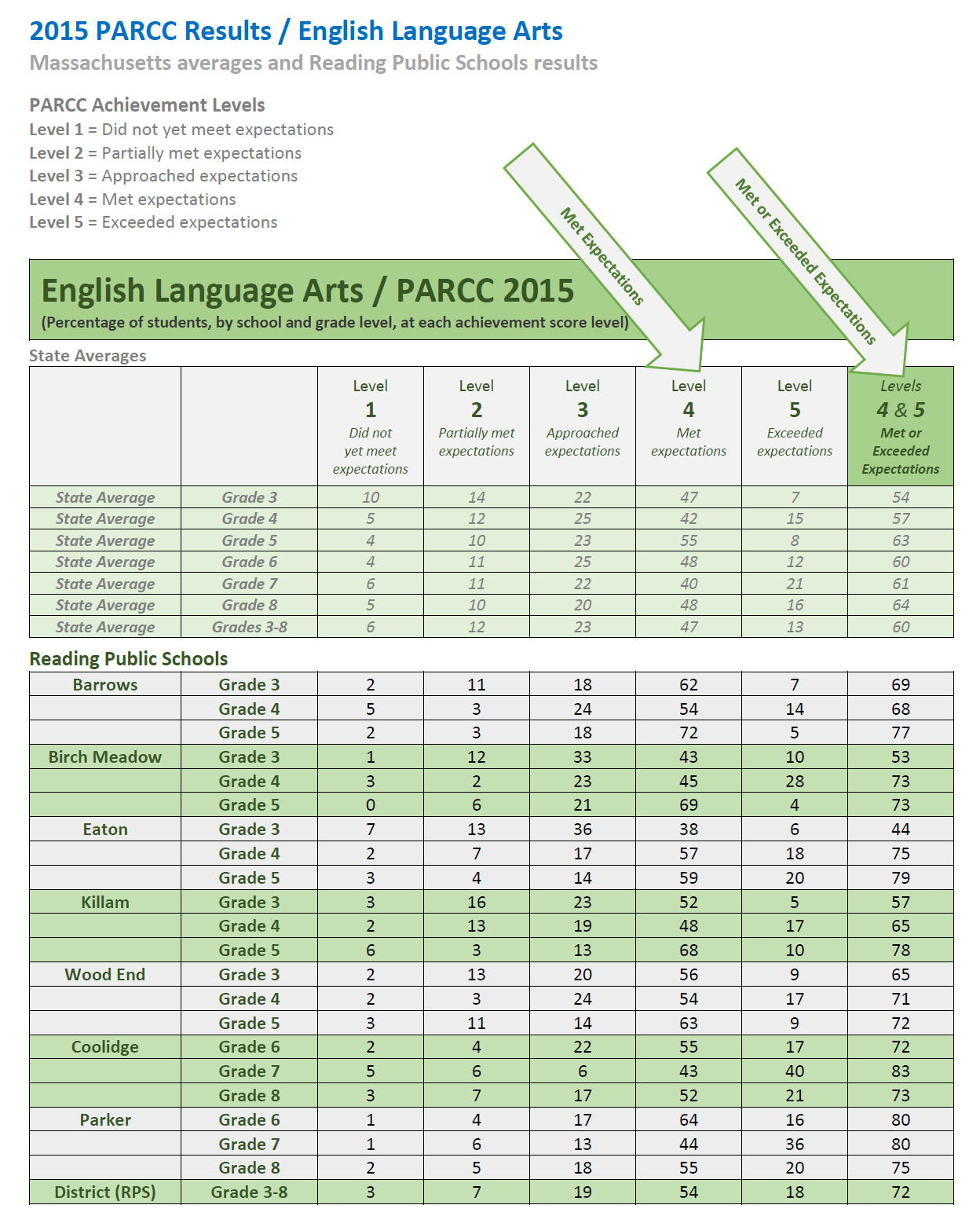
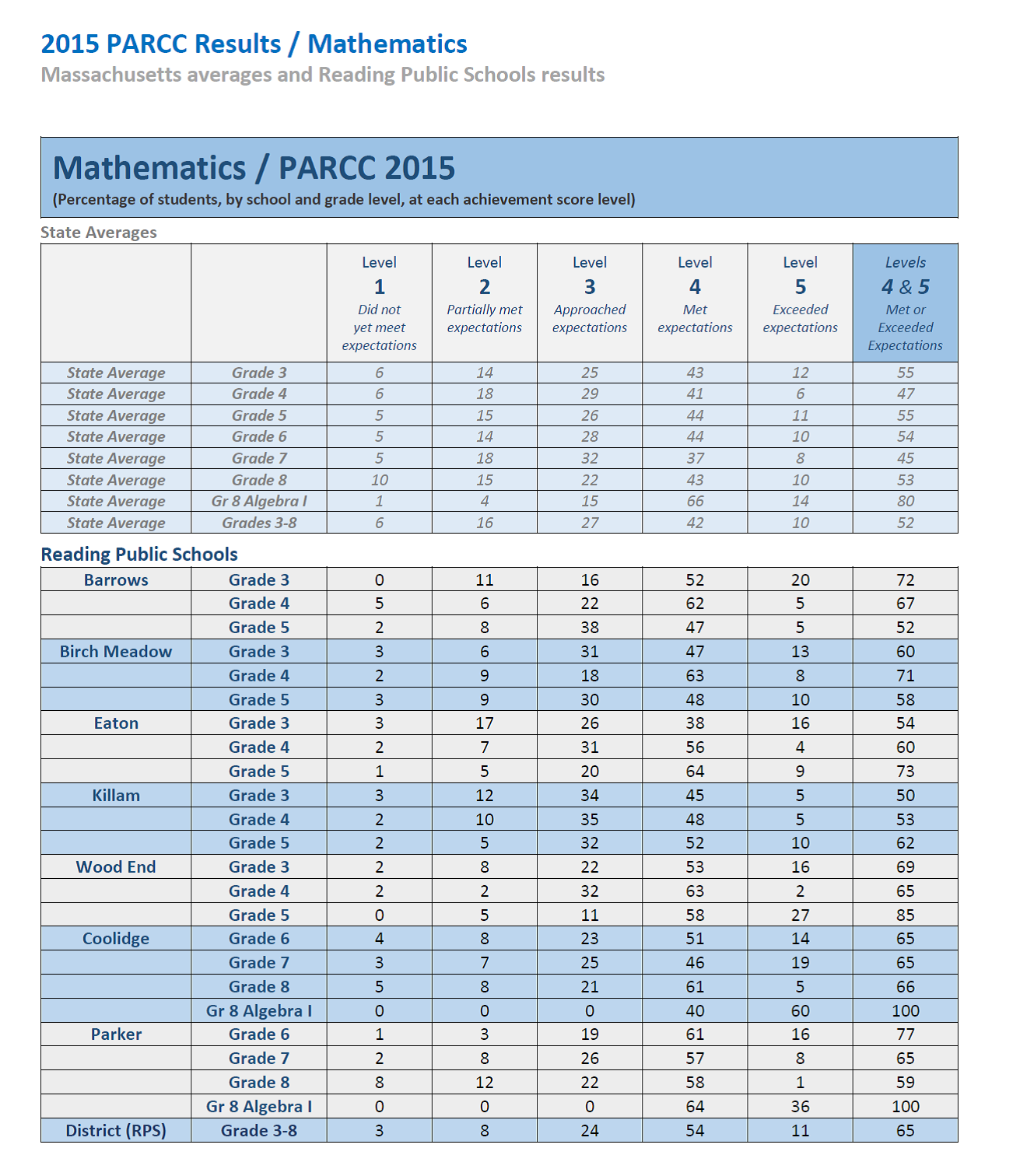
We are beginning to see the results of our hard work in literacy and mathematics on our state assessments. The students who took the Grade 10 MCAS assessments that I mentioned to you earlier were in middle school when we began implementing the revised frameworks. In addition, later this week, the first results of our next generation state assessment in Grades 3-8, the PARCC, will be released. Preliminary results show that our students overall did very well, with achievement and student growth scores well above the state average. These strong results are an indication that we are heading in the right direction and is a tribute to the dedication and commitment of our teachers, principals, and central office administrators.
We continue to work diligently to assure that the funding that we receive from the community and other sources is spent on what will most benefit our students. In 2014, the Center for American Progress updated a report that they first released in 2011 on a district by district analysis of educational productivity. This project develops a set of relatively simple productivity metrics in order to measure the academic achievement that a school district produces relative to its spending. I am pleased to announce that Reading has the fourth highest educational productivity rating in our Commonwealth. This strong measure is due to prioritizing our resources on the classroom and practicing strong fiscal management practices. In addition to the above, we have been working closely with Town Officials to analyze our largest revolving accounts in Full Day Kindergarten, Extended Day, Special Education Tuition, and RISE. Through this analysis, which has been reviewed by both the Board of Selectmen and the Reading School Committee, a set of guidelines has been established as to what the minimum amount of funding should be charged to each revolving account annually to cover the expenses for that program. We will continue to work closely with Town Officials to implement these best practices.
We are also proud of the maintenance and care of our facilities and are very appreciative of the support that we received from Town Meeting last year to fund six modular classrooms. I am pleased to report that this project was completed in early October, has reached substantial completion, received permanent certificates of occupancy and we received a credit of $15,000 for construction delays. These additional classrooms have provided great learning spaces for our kindergarten students and has given us the space necessary to maintain our educational programs at the elementary level.
Over the last few months, we have been working with Town Officials to restructure our facilities department and during this Town Meeting session, you will be voting on some budgetary shifts that will finalize a structure that will create a shared facilities model between town and schools. This revised model will continue to place an emphasis on the preventative maintenance and care of all of buildings, continue to control costs, and provide greater oversight and collaboration on our operations between town and schools. I would like to commend the collaboration between the Board of Selectmen and the School Committee, as well as Town Manager Robert Lelacheur and Director of Facilities Joe Huggins on this restructuring process. We have also seen similar collaboration between town and schools during this past year in technology and network management and Human Resources services. These examples of collaboration allow us to share best practices between departments, create efficiencies where possible, make available redundancies in an emergency and provide the best services possible with available funding.
Everything that you have heard thus far in my remarks would not be possible without strong and dedicated leadership. I want to take a moment and recognize the efforts of our building principals, building administrators, directors and central office administrators, many of who are here this evening. This hard-working group of individuals consistently goes well beyond their job description in leading our schools and departments through some very challenging times. Without their direction, we would not be able to have made the necessary changes to continually improve our schools and learning for our students, past, present, and into the future. Thank you for what you do for the children of Reading.
Updates and Moving Forward
Over the last several months, I have had the opportunity to meet with over 300 staff, parents, and community members in community forums to assess where we are as a school district. We discussed the strengths of the Reading Public Schools, the areas to strengthen, the new programs or initiatives that we need to begin, as well as, the current programs or initiatives that need to be changed or stopped. I collected hundreds of comments through these community forums, looked for themes and patterns and supported the findings with additional data from a variety of credible sources including state assessment data, the Walker Institute Report, which is a review that we did on our special education services last year, staff exit data, the Youth Risk Behavior Survey and student and staff survey data. For the remainder of my remarks, I would like to share with you some of the key points.
Overall, the community and staff gave positive remarks about the Reading Public Schools. In the focus group sessions, the consistent strengths that emerged include the quality and dedication of our teaching staff and administrators, our students who come to school every day ready to learn, and the commitment that our parents make to our schools. Our data also showed that we have strong special education programs, significant opportunities for our students to participate in extra-curricular activities, athletic programs, and extended field trips, and the access that students have to technology in our district.
We are also beginning to see some positive downward trends in some of our key Youth Risk Behavior Data. As many of you know, the Youth Risk Behavior Survey is administered to all Grade 6-12 students every two years. Since 2005, we have seen significant decreases in the use of cigarettes, alcohol, and marijuana. This is a testament to the collaboration and partnership with the Town of Reading, Reading Public Schools, the RCASA, and the Reading Police Department. I want to show you a clear example of this collaboration.
In 2005, the use of alcohol by our high school students was at a much higher rate than today. Due to the work of the Board of Selectmen who passed a revised Town Liquor Policy in 2009, our School Committee who passed a revised chemical health policy for students who participate in extra-curricular activities and athletics in 2011, and our Police Department, who began implementing compliance checks and a zero tolerance policy for our youth, we have seen a significant decrease in the use of alcohol by our high school students. This is a concrete example how a collaborative effort of policy changes and implementation can result in a positive benefit for our youth. Although we would like these percentages to be at 0%, the results are showing that our efforts are having an impact.
Although the data and the forums show we have a lot to be proud of in our schools, the information gathered also shows that there are areas we need to address so that we can maintain the level of excellence that we have taken pride in over the last several years. Addressing these areas will be critical to the long term success of our school district.
One area that continues to surface is the overall behavioral health of our students. Although we have seen some very positive results in the latest administration of the Youth Risk Behavior Survey, we are seeing some troubling trends as well. In the slide behind me, we have seen slight increases since 2005 in the use of some of the more dangerous drugs, such as prescription medication, heroin, hallucinogens, and inhalants. Synthetic marijuana is emerging as a potent and risky alternative for students. In addition, 24% of our community’s 14-18 year olds stated that they have used electronic cigarettes with nicotine products, also called vaping, which is a dangerous upward trend.
We are also concerned about the emotional health of our adolescents. Over the last 10 years, we have seen increases in the percent of teens who have felt sad or hopeless for more than 2 weeks in a row, are involved in non-suicidal self-injury, or have engaged in suicidality. In addition, during the 2014-15 school year, 55 RMHS students were hospitalized for anxiety, suicidal tendencies, and/or depression. We have seen increases at our elementary and middle schools as well. Our high school students indicated on the YRBS that the major stressors in their life are increased workload, expectations about school and lack of sleep. Although these increases are not isolated just to Reading, we are concerned that the numbers of incidents in Reading is higher than the state average. As a community, we have taken significant steps to address these increased concerns through our partnerships with the Reading Coalition Against Substance Abuse and your support in previous budgets with programs and staffing that supports behavioral health. As I reported last year, the Town and the School Department received three Federal grants, totaling 1.95 million dollars, to continue to help address the overall behavioral health of our youth. The first grant continues the great work that RCASA has done over the last several years. The second grant will allow the Reading Public Schools to train a minimum of 584 school educators, school support staff, first responders, youth workers, and faith leaders in Youth Mental Health First Aid to identify, understand, and respond to signs of mental illnesses and substance use disorders in our youth. So far, over 250 people have been trained in this area. The third grant will implement a highly sustainable, multi-tiered system of supports to improve school climate and behavioral outcomes for all students. We have made tremendous progress in this area in just one year. These three grants ensure that we will be able to move forward in creating structures, systems, and processes throughout our community to reach and engage all of our youth, particularly those youth who may be vulnerable to risky behaviors such as substance abuse or creating harm to themselves or others. These initiatives, combined with the work that we have done over the last several years in school safety with the Reading Police and Fire Departments, places our community as a leader in proactively addressing the overall safety of our children. As we all know, if students do not feel physically and psychologically safe in school, they will not learn, no matter what curriculum, technology, or teacher you put in front of them. I would like to thank the Reading Police and Fire Departments and the Reading Coalition Against Substance Abuse, under the leadership of Chief James Cormier, Chief Greg Burns, and RCASA Executive Director Erica McNamara, for the partnership that they have forged with the Reading Public Schools over the last several years and their leadership and efforts in creating safe and supportive environments for our children. In addition, I would be remiss, if I did not thank Chief Cormier for all of his efforts and collaboration over the last several years in providing a safe environment for our students. Jim, I have enjoyed working with you over the last six years in my role as Superintendent and I wish you success and good health in your retirement.
Finally, I would like to spend a few minutes focusing on school funding, past, present, and future. I would like to preface my comments by stating that we are appreciative and value the financial support that our community has given to public education. Unfortunately, our latest state financial data shows that Reading ranks 305th out of 326 Massachusetts communities in per pupil spending, 118th out of the 125 communities in the Boston Metro Area and this ranking has been in steady decline since 2006. It is well documented that our community has a revenue challenge as we become more and more reliant on cash reserves each year to fund our budgets. It is to our town’s credit that through mutual respect and collaboration, town boards have stretched our dollars to provide the quality education and services, of which Reading is so proud.
Our continuing decline in per pupil expenditure is beginning to have an impact on our school system, especially during the times of transition that we are currently facing. Over the last five years, the average budget increase has been 2.64%, however, expenses in health care costs, utilities, supplies, special education costs and compensation have come in at much higher increases. This leads to less overall services and programs that can be funded for our schools. We are in the midst of tremendous educational change in our state and in our country with more rigorous curriculum frameworks, a next generation assessment system, and the expectation to make sure all students are college and career ready. We also need to address the areas that I mentioned earlier in behavioral health. During these times of transition, it is more important than ever to sustain our previous levels of support and to add resources to address additional needs. In the upcoming school year we will need to update our science and engineering curriculum, provide time and resources for teachers to implement these new curricula, continue to improve our special education services and programs, add more tutorial and social emotional support for struggling students, offer dedicated health education classes at our elementary and middle schools, increase our Advanced Placement course offerings at the high school and elective offerings at all levels, and update the High School Graduation requirements to help prepare our students for college and future opportunities.
Equally important, we need to continue to attract and retain the best educators. This past school year alone five educators left our district for higher compensation, better benefits and improved working conditions related to caseload and paperwork. In addition, four candidates who were offered positions in our school district declined to accept our offer and accepted a position in another school district for higher compensation and benefits.
Unfortunately, I see a similar trend occurring as we begin to prepare the FY17 budget. It is this ongoing pattern that, I believe, has placed our community at a cross roads. We have a decision to make in terms of what type of school district and town services we want and the resources necessary to sustain those programs and services. Because, without more resources, we will not be able to do over the long term what we are currently doing.
To conclude, I believe that this is an exciting, but uncertain time in public education and we have an opportunity to make positive substantive changes that have not been made since Education Reform was introduced in 1993. It is difficult work, but we are up to the challenge of providing the best learning experiences for our students. Those substantive changes that I mentioned earlier will take time and sustainable resources. I am proud of the work that our teachers and administrators do every day to improve teaching and learning in our district and I am excited by the enthusiasm and respectfulness of our students who arrive to school every day eager to learn. This is a testament to our parents and our community who value the importance of education and the role that it needs to play in a community. There is no question that a major indicator of the quality of life for everyone in a community can be measured by the quality of its schools and by a community’s commitment to its children. In this way, the quality of a school district affects every single person in a community, and the Town of Reading is no exception. But I also believe this is one of our greatest strengths.
Thank you for your time this evening. In my 32nd year as an educator, my 28th year now in the Reading Public Schools, and as proud parent of children who attend the Reading Public Schools, one who graduated two years ago and one who is graduating this year, I must say that I am so very proud to be a part of this community. I thank you for the privilege . . . and I look forward to working with you, as together, we continue to make Reading a place where all students can learn and succeed, a place where we develop the innovative leaders of tomorrow, and a place where our schools continue to provide the strong foundation for the future of this great community.
Thank you very much.


 The Journey-The Next Chapter