Opinion Article-Ed Tech is Not A Silver Bullet

The article below is written by Kerry Gallagher, who is a history teacher in Reading and a lawyer by training. She’s a regular panelist at education conferences and a contributor to education blogs like EdSurge and the Smarter Schools Project.  This article was from http://reading.wickedlocal.com/article/20150313/NEWS/150318862 and http://kerryhawk02.blogspot.com/.

All too often, educators hear lofty promises about the potential for emerging technologies to improve teaching and learning. Companies make bold claims that software will save teachers time and improve student outcomes. The teacher response is often skeptical. One Chicago teacher, Michael Beyer, suggested that even if software works, he’d argue against using it.

Of course, there are no silver bullets. Students and classrooms are different. School needs and infrastructures vary. While it’s obvious that technology alone is not going to revolutionize education, we are often presented with a false choice between adopting emerging technologies and investing in great teachers.

Tech savvy teachers are often frustrated by a national discourse that seems to ignore what is actually happening in today’s classrooms. Education is far from experiencing the massive disruption that we often hear about in other sectors, but we’re not living in the dark ages either. Teachers are using technology tools to get organized and improve basic processes, enhance the student-teacher relationship, provide students access to high-quality multimedia content, and help students demonstrate what they’ve learned in ways that are more meaningful to them.

Just as teachers strive to meet students where they are, technologies can be personalized to reflect the subject areas and teaching styles of educators. I use Evernote to keep digital notes. Several educators I respect prefer OneNote or Google Drive. What is important is that these tools provide a way for teachers to stay organized, track their thoughts, and then look back at those thoughts for more formal reporting.

My students find digital note keeping beneficial as well. In an article my students and I co-wrote, one student said, “It is far neater than a bundle of papers that are randomly organized. Even a messy person is forced to be neat.” Note taking and organizational improvements are not revolutionary advances, but they make a profound difference in the classroom. Without these tools, teachers and students fall back into the old problems of folders and lockers bursting with papers that are torn, outdated, and often thrown away—along with the valuable information and learning they represent.

These tools are not meant to replace great teaching and high-quality relationships between students and educators. My students made it clear to me early in the school year that their relationship with a teacher is the best predictor of how engaged and successful they will be in any given class or subject. Ed tech tools often enhance, not diminish, those connections. Technology ensures that I am available to help my students more effectively than ever before. As a high school educator, I see each of my 120 students for only 55 minutes a day, but learning does not start and stop when the bell rings. Communication and social media tools like Remind, Twitter, and email guarantee that I can be there for my students when they need me. Rather than removing that essential interpersonal aspect of education, technology can enhance it.

Ed tech-enabled content presents an opportunity to help learners access the high-quality multimedia resources. When I was a student and it was time for a video, the teacher wheeled in a heavy television and VCR on a cart and we all sat passively, all watching the same video. Today, tools like eduCanon, Bubblr, and Teachem enable students to view and interact with videos that meet their individual needs and interests, and even assess their understanding as they watch.

While the educator is usually the content expert in the room, students are experts when it comes to their own learning. The way students choose to demonstrate and communicate that learning provides invaluable insight to inform “assessment.” Standardized testing only addresses a small percentage of what our children are learning, and software geared to standardized testing should not be our exclusive technology focus. I agree with Beyer that, “Instead of a factory-model of education, we need a lab and studio model of education.” I applaud his call for a model “in which the students design the questions and create the tests themselves.” What he fails to appreciate, however, is that technology makes this type of learning model easier to implement than ever before.

Ed tech tools will never replace great teaching, but they are helping great teachers develop better relationships with their students, and deliver high-quality content. The goal of any curriculum or teaching aid has always been to boost student achievement and technology is no different. It isn’t a silver bullet, but it’s not something to be scared of either. It’s simply one more tool in the toolbox.

RMHS “Robockets” Team Performs Very Well at NE FIRST Event

Robockets

A Panoramic View of the NE FIRST Event at RMHS Field House

Last weekend, the Reading “Robockets” team joined 39 other teams from all over New England to compete in the NE FIRST North Shore District Robotics Event, which was held at our own RMHS Field House.  This year’s game is called RECYCLE RUSH, which is a recycling-themed game played by two Alliances of three Robots each. Robots score points by stacking Totes on Scoring Platforms, capping those stacks with Recycling Containers, and properly disposing of pool noodles, representing Litter. In keeping with the recycling theme of the game, all game pieces used are reusable or recyclable by teams in their home locations or by FIRST® at the end of the season. Each Alliance competes on their respective 26 ft. by 27 ft. side of the playing field. Each RECYCLE RUSH Match begins with a 15-second Autonomous Period in which Robots operate independently of their drivers. During this period, Robots attempt to earn points by moving themselves, their Yellow Totes, and their Recycling Containers into the area between the white scoring platforms, called the Auto Zone. During the remaining two minutes and 15 seconds of the match, called the Teleop Period, Robots are controlled remotely by student drivers located behind the walls at the ends of the field. Teams on an Alliance work together to place as many Totes on their white Scoring Platforms as possible.

During the weekend, Reading finished 11th in the qualifying round out of 40 teams.  They then became eligible to compete in the competition round of 8 alliances where they finished as the third best alliance in the entire competition.  In addition, Reading received one of the prestigious Judge’s awards, the Entrepreneurship award for their outstanding business plan, implementing that business plan, and reaching out to the greater community.  Congratulations to the Robockets who now will compete in Smithsfield, Rhode Island on March 20-21st.  If they rank high enough, they will be invited to compete in the district tournament at WPI in April.

Robockets2

The Robockets Team Pit Area at the Event

Some additional thoughts about last weekend’s event

Over the last several years, our school district has focused on our mission of Instilling a joy of learning and inspiring the innovative leaders of tomorrow.  The NE FIRST program and this competition clearly supports that mission.  FIRST goes far beyond what those other STEM opportunities provide because for six weeks, students are given a challenge that goes well beyond building a robot to perform a task.  Students have to be entrepreneurs and raise funds, they have to use technology and engineering skills to develop a design and plan, they have to market and brand their team to the community and to sponsors, they have to have people willing to lead, and those that are willing to follow.  They have to test ideas, fail at those ideas, and retest them with new solutions. Team members have to work together because if they do not, they will not be able to fulfill your challenge.  And, they had to face unexpected obstacles, like multiple snow storms.  All of this had to be done in 6 weeks’ time, while at the same time they need to continue to participate in school, a job, their family, and other responsibilities.  It is evident that this process prepares students for life with skills that will give them the ability to face many more difficult challenges.

The NE FIRST Teams all seemed to have three common themes.  First, there was this consistent buzz of positive energy and enthusiasm.  Many participants said during the event that this program has changed their life because it is exciting, challenging, builds lasting friendships and is hard work.  One student even quoted saying, that “this is the hardest fun that he has ever had, but he would never stop doing it”.  It is this contagious enthusiasm that was heard consistently all weekend.

Another theme that was observed was the different types of students that participated.  One would think that since this was a robotics event, most students would want to be engineers.  This was clearly not the case as teams had not only future engineers, but future artists, entrepreneurs, storytellers, scientists, teachers, architects, and computer software designers.  What is evident is that this program is for every student, regardless of their background, skills, or talents.  Each member of the team finds his or her own role and contributes in a very powerful way.

The final theme that emerged is that this process is more than building a robot to complete a task.  Participating in FIRST teaches skills that a student will need well beyond this competition.  Skills like communication, time management, innovation, problem solving, creativity, and most importantly, teamwork.  These are the skills that will prepare students for life, regardless of what field they pursue.

The students that were at the event last weekend could potentially be the future Leonardo DaVinci, Henry Ford, Steve Jobs, Ellen Ochoa, and other skilled entrepreneurs, scientists and engineers of their generation.  They are part of the generation that will be solving the environmental, fiscal, and technological problems that face our communities, our country, and our world.  It is clear that with events like this, our region is in good hands and their participation in this FIRST program prepares them to work as a team and tackle those challenges.

The overall running of the event was a complete success and like any event of this magnitude it took a Team to make the event run smoothly.  Special thanks goes to NE FIRST,  Co-Chairs Sanat Patel and Kyle Henry, our Reading Robockets Team and their parents, our Facilities Department and our technology departments for the time and effort in planning the logistics of this past weekend.

Robockets3

The Robockets

Reading Educators Recognized

We are pleased to announce that two Reading Educators, RMHS Physics and Engineering Teacher Steve Cogger and RMHS Social Studies Teacher Kerry Gallagher have been recently recognized for their work and efforts in our schools.

Cogger Article picture

The iSense tool used in the project.

Steve Cogger, who is a physics and a PhD student in STEM Education at Tufts University in Medford, Massachusetts, was recently published in the February Issue of The Science Teacher Magazine, for his work on recreating the traditional carbon ticker tape lab with a Human Ticker Tape Lab that uses a SMART Phone App and GPS devices.  The article, Doing the Data Walk, Ticker Tapes for the 21st Century Physics Student, describes how students in the Human Ticker Tape lab, examine data patterns that they created and collected on the RMHS Football Field. After the outdoor activity, they analyze patterns created by their lab group and the other groups in class. Students can observe different patterns and provide evidence for causality in their explanations of their data. You can access the article below.

Cogger Science Teacher Article

Gallagher School Committee

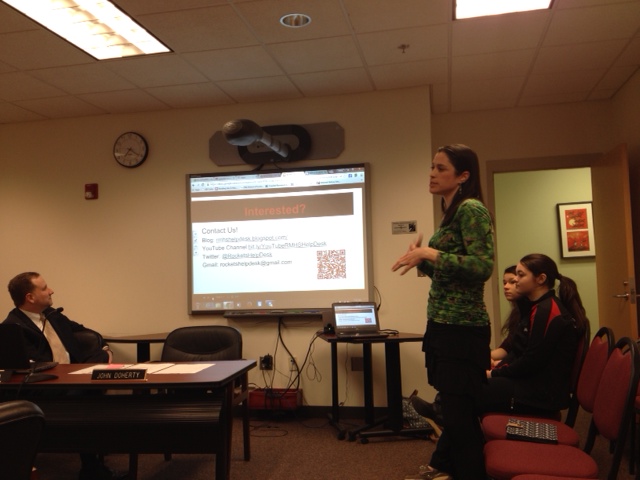
Kerry Gallagher presenting at a recent School Committee meeting.

RMHS Social Studies Teacher Kerry Gallagher has been recently notified that she will be joining a panel of other distinguished educators at the Personalized Learning Symposium at Stanford University in late March.  This Symposium explores current trends in personalized and online learning research and best practices for digital curriculum and blended learning implementation.  Kerry will be joined on the panel with Roger Cook, Superintendent of Schools for the Taylor County School District in Campbellsville, Kentucky. and Brandon Phenix, Director of Blended Learning at ReNEW Schools in New Orleans, Louisiana.  The panel discussion will focus on the 50 States Project that the Reading Public Schools and Kerry’s classroom were a part of over the past year.  You can read about the 50 States Project here, including an article that she wrote as part of the project.  While at Stanford, Kerry will also have the opportunity to work with the people who are involved in the Stanford History Education Group, an ongoing research group for students across the university interested in issues of how history is taught and learned.

Congratulations to both of our educators for their well deserved recognition and for the work that they do for students.

Weekly Pathways Newsletter Now Posted

Growth

Good Morning,

It was good to finally go through a full week of school in over a month.  Let’s hope we can continue that trend this week!

Below is the link to this week’s Pathways Newsletter.  This week we have information, stories and photos about the upcoming RMHS Drama Production, Antigone, the recent Joshua Eaton World Café, the Taste of Metro North, Seven steps to good digital parenting, and a math problem that will get third graders (and maybe others) thinking.

Have a great rest of the day and week ahead.

Pathways Newsletter V1N24

Snow Removal Efforts on School Roofs

As you know, over the last month, we have received over 100 inches of snow in the Greater Boston area.  One of the major concerns with this much snow is always the effect that the additional weight may have on our school roofs.  Our facilities department has spent a significant amount of time mitigating potential snow issues on the school roofs. As a result the department has been proactive during weekends, February vacation and after each snowstorm in monitoring and removing snow from the roofs in the district; paying close attention to the most critical areas and buildings in the district. These areas include large flat roofs, transition and drifting areas and areas surrounding rooftop equipment.

Our efforts were and continue to be daily monitoring of the structures in the district. These efforts include building walks and checks both internally and externally for any signs of damage or structural issues. Of particular areas to investigate externally include: North – facing elevation changes & drift walls for excessive build up of ice and snow, roof top equipment, flat areas of roof and changes in roof heights where drifts can accumulate. Internal building walks look for the following: sprinkler heads that have pushed below ceiling tiles, displaced ceiling tiles or hanging light fixtures, sticking or jamming doors/ cabinets, bent or displaced sprinkler lines, sagging roof insulation and or serious roof leaks.

In addition, during the last two weeks our staff in conjunction with external roofing contractors and other external vendor resources reviewed the areas noted above and systematically removed snow from the buildings in the district which presented the most critical. Those buildings that did not have dedicated staff on the roof, did have dedicated staff removing snow and ice with roof rakes to alleviate any concern with the low risk buildings.   Each and every school in the district was treated for snow removal either from the ground or with staff on the roofs.

As with any storm and with wind in the forecast, drifts can re-accumulate in those high risk areas. As a result we are having our custodial & maintenance staffs continually monitor the buildings and the roofs for any increased areas that need to be addressed.

If you have any questions or concerns about the roofs, please contact your child’s building principal or the Reading Public Schools Facility Department at 781-944-5800.

Latest Pathways Newsletter

Growth

Welcome Back!  We hope that families and students had a great February break.  Below is a copy of this week’s Pathway’s Newsletter with photos from Parker Middle School’s trip to Costa Rica, Snow filled pictures of our schools, stories about Globe Art and Writing Scholastic Winners, and more!

Hopefully, the snow days are done and we can have a consistent stretch of school between now and April vacation.

Have a great day and week…

Pathways Newsletter V1N23

The Impact of Snow on School Days

A Snow Bank Outside of Coolidge Middle School

A Snow Bank Outside of Coolidge Middle School

This winter has been unprecedented in a lot of ways, most notably, the amount of snow days that we have had to take as a school district.  Currently, we have taken six snow days, which brings us to June 25 as the last day of school.  Ironically, we have ended the last two years on June 25th so let’s hope at this point that we can make it three years in a row.

Because of the excessive snow days, there has been a lot of discussion about what we can and cannot do in regards to making up the time. Our primary goal is to provide structured and meaningful learning time for our students. Massachusetts is one of a few states that has both a time on learning requirement (900 hours for elementary and 990 hours for secondary) and a school day requirement (180 days).  Recently, we received the following information from the Department of Elementary and Secondary Education:

“With respect to missed school days, the current policy is online. Although the commissioner has authority to reduce the student learning time requirements in extraordinary circumstances, that has always been a last resort. Districts should be making a good faith effort to adjust school calendars for the balance of the year. If the remainder of the winter yields continued weather emergencies, ESE will reevaluate whether there is a need to grant waivers to individual districts, but the agency does not expect to issue a general, state-wide waiver.

The Department has received inquiries regarding so-called “blizzard bags,” assigned work sent home with students in advance of an expected storm. In many cases, this work appears to be very similar to normal homework assignments; there is educational value, but it does not necessarily meet the standard for structured learning time. For this approach to count toward the student learning time requirements, school districts must ensure that such work is structured learning time, is substantial, and has appropriate oversight and teacher involvement. To the degree that learning outside of the school setting may rely upon parental involvement or access to technology, districts must also account for the widely varying circumstances in students’ homes. Districts are encouraged to share their experiences as they experiment with different models so that all can learn about their effectiveness and develop examples of best practices.

Some districts have asked about lengthening the school day so that the minimum total learning time requirement (900 hours in elementary schools and 990 hours in secondary schools) can be met in fewer than 180 days. The Department has not previously approved such arrangements. However, if a district has made every effort to reschedule the lost days, including the use of April vacation and professional development days, we are willing to consider proposals for longer days to make up any remaining days. Such proposals must demonstrate a positive impact on student learning. The amount of time being added to a day must be significant, the reduction in the total number of days must be minimal, and districts will need to provide information on implementation issues including teacher contract provisions, bus schedules, parent input, and students’ ability to participate in afterschool activities.”

At this point, we are in good shape compared with several other communities who started school after Labor Day and will be ending the school year on June 25th.  If we have additional school cancellations, we will need to review some other alternatives.

Hopefully, this weather pattern will change, the air will warm up, and spring will come soon!


Active Parenting of Teen Online Program-Unique Opportunity Sponsored by RCASA

Good Morning,

Please see the attached information regarding an Active Parenting of Teens Online Program being sponsored by the Reading Coalition Against Substance Abuse.  At this time only 25 slots are available for this unique program.

If you have any questions, please contact Julianne DeAngelis at jdeangelis@ci.reading.ma.us.

active parenting flyer

No School for Tuesday, February 10th

Due to the significant snowfall accumulations that we have received over the last several days, there will be no school or extended day programs for the Reading Public Schools for Tuesday, February 10th.  Unfortunately, there is simply just too much snow for the students to come to school safely tomorrow.

Have a great day and stay safe.

No School for Tuesday, February 10, 2015

No School for Tuesday, February 10, 2015

A Message from the Town of Reading Regarding the Storm

Good Evening,

The message below is from the Town of Reading.

DUE TO THE IMPENDING SNOW STORM, A SNOW EMERGENCY PARKING BAN IS IN EFFECT UNTIL TUESDAY AT 7 AM. ALL VEHICLES MUST BE OFF THE STREET OR THEY WILL BE TOWED. PLEASE DO NOT PUT YOUR RUBBISH CURBSIDE AS MONDAY’S PICK UP HAS BEEN CANCELLED AND ALL RUBBISH COLLECTIONS WILL BE MOVED FORWARD BY ONE DAY. READING PUBLIC SCHOOLS, TOWH HALL, LIBRARY, AND THE SENIOR CENTER WILL BE CLOSED FOR THE ENTIRE DAY ON MONDAY, AND ALL TOWN NIGHT MEETINGS AND ACTIVITES HAVE BEEN CANCELLED. FOR FURTHER UPDATES AND CHANGES TO THIS ADVISORY, PLEASE VISIT WWW.READINGMA.GOV. THANK YOU.