
Reading Educators Recognized

We are pleased to announce that two Reading Educators, RMHS Physics and Engineering Teacher Steve Cogger and RMHS Social Studies Teacher Kerry Gallagher have been recently recognized for their work and efforts in our schools.

Cogger Article picture

The iSense tool used in the project.

Steve Cogger, who is a physics and a PhD student in STEM Education at Tufts University in Medford, Massachusetts, was recently published in the February Issue of The Science Teacher Magazine, for his work on recreating the traditional carbon ticker tape lab with a Human Ticker Tape Lab that uses a SMART Phone App and GPS devices.  The article, Doing the Data Walk, Ticker Tapes for the 21st Century Physics Student, describes how students in the Human Ticker Tape lab, examine data patterns that they created and collected on the RMHS Football Field. After the outdoor activity, they analyze patterns created by their lab group and the other groups in class. Students can observe different patterns and provide evidence for causality in their explanations of their data. You can access the article below.

Cogger Science Teacher Article
Gallagher School Committee

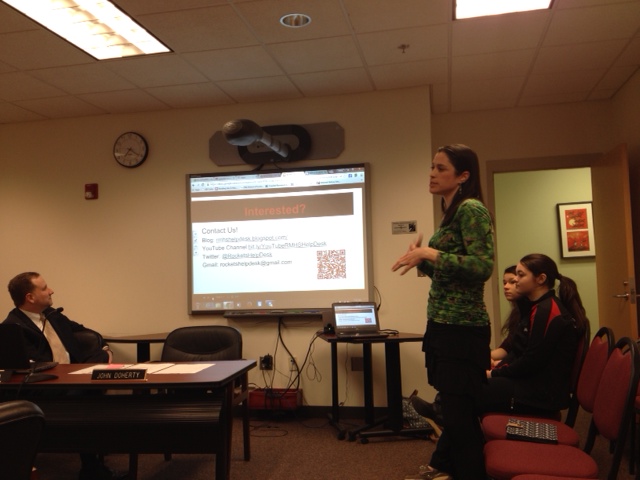
Kerry Gallagher presenting at a recent School Committee meeting.

RMHS Social Studies Teacher Kerry Gallagher has been recently notified that she will be joining a panel of other distinguished educators at the Personalized Learning Symposium at Stanford University in late March.  This Symposium explores current trends in personalized and online learning research and best practices for digital curriculum and blended learning implementation.  Kerry will be joined on the panel with Roger Cook, Superintendent of Schools for the Taylor County School District in Campbellsville, Kentucky. and Brandon Phenix, Director of Blended Learning at ReNEW Schools in New Orleans, Louisiana.  The panel discussion will focus on the 50 States Project that the Reading Public Schools and Kerry’s classroom were a part of over the past year.  You can read about the 50 States Project here, including an article that she wrote as part of the project.  While at Stanford, Kerry will also have the opportunity to work with the people who are involved in the Stanford History Education Group, an ongoing research group for students across the university interested in issues of how history is taught and learned.

Congratulations to both of our educators for their well deserved recognition and for the work that they do for students.
Reading Memorial High School Makes Advanced Placement Honor Roll

AP Honor Roll

The Reading Public Schools is pleased to announce that Reading Memorial High School is one of 547 schools and districts in the U.S. and Canada being honored by the College Board with placement on the 5th Annual AP® District Honor Roll for increasing access to AP course work while simultaneously maintaining or increasing the percentage of students earning scores of 3 or higher on AP Exams. 2014 is a milestone year for the AP District Honor Roll, and more districts are achieving this objective than ever before. Reaching these goals indicates that the district is successfully identifying motivated, academically prepared students who are ready for the opportunity of AP. Since 2012, Reading Memorial High School has increased the number of students participating in AP while improving the number of students earning AP Exam scores of 3 or higher.

Superintendent of Schools, Dr. John F. Doherty stated, “I would like to commend the staff of Reading Memorial High School for their hard work in providing access to quality Advanced Placement Courses for our students.  It is our goal over the next few years to continue this trend of increasing participation in these challenging courses for all students.”

Data from 2014 show that among African American, Hispanic, and Native American students with a high degree of readiness for AP, only about half of students are participating.  The first step to delivering the opportunity of AP to students is providing access by ensuring courses are available, that gatekeeping stops, and that the doors are equitably opened so these students can participate.  Reading Memorial High School is committed to expanding the availability of AP courses among prepared and motivated students of all backgrounds.

“The devoted teachers and administrators in this district are delivering an undeniable benefit to their students: opportunity. When coupled with a student’s hard work, such opportunities can have myriad outcomes, whether building confidence, learning to craft effective arguments, earning credit for college, or persisting to graduate from college on time.” said Trevor Packer, the College Board’s senior vice president of AP and Instruction. “We applaud your conviction that a more diverse population of students is ready for the sort of rigor that will prepare them for success in college.”

Helping more students learn at a higher level and earn higher AP scores is an objective of all members of the AP community, from AP teachers to district and school administrators to college professors. Many districts are experimenting with a variety of initiatives and strategies to determine how to simultaneously expand access and improve student performance.

In 2014, more than 3,800 colleges and universities around the world received AP scores for college credit, advanced placement, and/or consideration in the admission process, with many colleges and universities in the United States offering credit in one or more subjects for qualifying AP scores.

Inclusion on the 5th Annual AP District Honor Roll is based on the examination of three years of AP data, from 2012 to 2014, looking across 34 AP Exams, including world language and culture. The following criteria were used.

Districts must:

  • Increase participation/access to AP by at least 4 percent in large districts, at least 6 percent in medium districts, and at least 11 percent in small districts;
  • Increase or maintain the percentage of exams taken by African American, Hispanic/Latino, and American Indian/Alaska Native students; and
  • Improve performance levels when comparing the percentage of students in 2014 scoring a 3 or higher to those in 2012, unless the district has already attained a performance level at which more than 70 percent of its AP students are scoring a 3 or higher.

When these outcomes have been achieved among an AP student population in which 30 percent or more are underrepresented minority students (Black/African American, Hispanic/Latino, American Indian/Alaska Native) and/or 30 percent or more are low-income students (students who qualify for free or reduced-price lunch), a symbol has been affixed to the district name to highlight this work.

The complete 5th Annual AP District Honor Roll can be found here.